



Crowded Fish, Indoor Fish Farm RAS – When Water Quality Becomes Everything (or, For Our Food Sources, Ozone Works)
If you operate a Recirculating Aquaculture System (RAS) or you are considering building one, you already know that the single biggest threat to your fish is the water they live in. Pathogens multiply. Organic waste builds up. Dissolved oxygen drops. And because you are recirculating most of that water rather than replacing it, every problem compounds over time.
Ozone is one of the most effective tools available for keeping RAS water clean, safe, and biologically productive. This post breaks down how it works, what science says, what it will not do, and how to size a system for your operation.
The Core Problem With Recirculating Systems
A Recirculating Aquaculture System (RAS) is an indoor fish farm. Water is continuously filtered and reused in RAS. So rather than draw fresh water from a river, pond, or well, a typical RAS recirculates 90–95% of its water volume. That makes raising high-value species such as bass, tilapia, trout, and shrimp possible outside of natural habitats. Landlocked farmers in the Midwest can raise freshwater fish year-round in a warehouse.
The tradeoff is density. Keeping large numbers of fish in RAS means that dissolved waste, pathogens, and organic matter accumulate. Mechanical and biological filtration handles a lot of that load, but it has limits. Pathogen pressure stays high. Dissolved organic matter clouds the water and stresses fish. Bacterial diseases spread rapidly when they take hold.
That is where ozone enters the picture.
What Ozone Actually Does in RAS
Ozone is an unstable form of oxygen. That instability is precisely what makes it useful. It reacts with organic material, bacteria, and other contaminants, then reverts back to oxygen. In RAS, ozone works on three problems at the same time.
Ozone Kills Bacteria and Pathogens
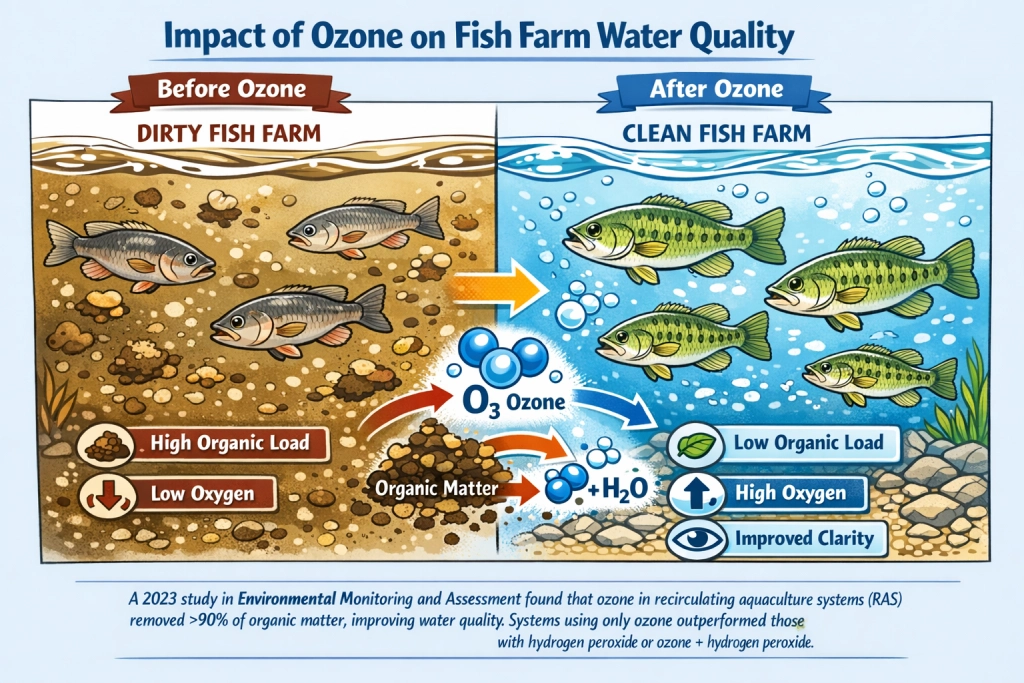
Ozone attacks the cell walls and internal structures of bacteria and pathogens directly. Research published in Frontiers in Microbiology (Yousef et al., 2024) confirms ozone works. They found that ozone dissolved into water kills E. coli, Listeria, Salmonella, and Pseudomonas aeruginosa. At doses that do not harm living fish, ozone is still effective. A study on tilapia found that ozone nanobubble treatments reduced two of the most common bacterial threats in fish farming. Those are Streptococcus agalactiae and Aeromonas veronii. In fact, they found that the reduction was 99.93% to 99.99% after repeated treatments. Note, no fish were harmed at properly controlled dose levels. (Jhunkeaw et al., 2020, Aquaculture).
Ozone Clears Dissolved Organic Matter
In a recirculating system, dissolved organic matter (DOM) accumulates even after mechanical filtration. Fish waste and feed residue float invisibly in the water, stressing fish and fueling bacterial growth. A 2023 study in Environmental Monitoring and Assessment found that ozone treatment in RAS removed more than 90% of that organic material from the water. Systems using ozone alone outperformed those using hydrogen peroxide or a combination of both.
Ozone Boosts Dissolved Oxygen
As ozone breaks down in water, it reverts to oxygen. That is a significant benefit in aquaculture. Higher dissolved oxygen levels support faster fish growth rates. It also reduces stress mortality. These are two outcomes that directly affect profitability.
Ozone Leaves No Chemical Residue
Unlike chlorine-based disinfectants, ozone leaves nothing behind after it does its work. There is no chemical residue to flush out before treated water returns to the fish tanks.
What Ozone Can Do (If Not Controlled)
Correct usage of ozone is imperative. Ozone is a powerful oxidizer. Too much residual dissolved ozone in direct contact with fish can damage gill tissue. This is not a reason to avoid it. Making sure to size and monitor the system properly ensures success.
In practice, fish farmers apply ozone in a dedicated tank outside of the main fish tank loop. Ozone does its work there, then the treated water allows residual ozone to break down before it re-enters the fish tank. The fish never come into direct contact with high-concentration ozone.
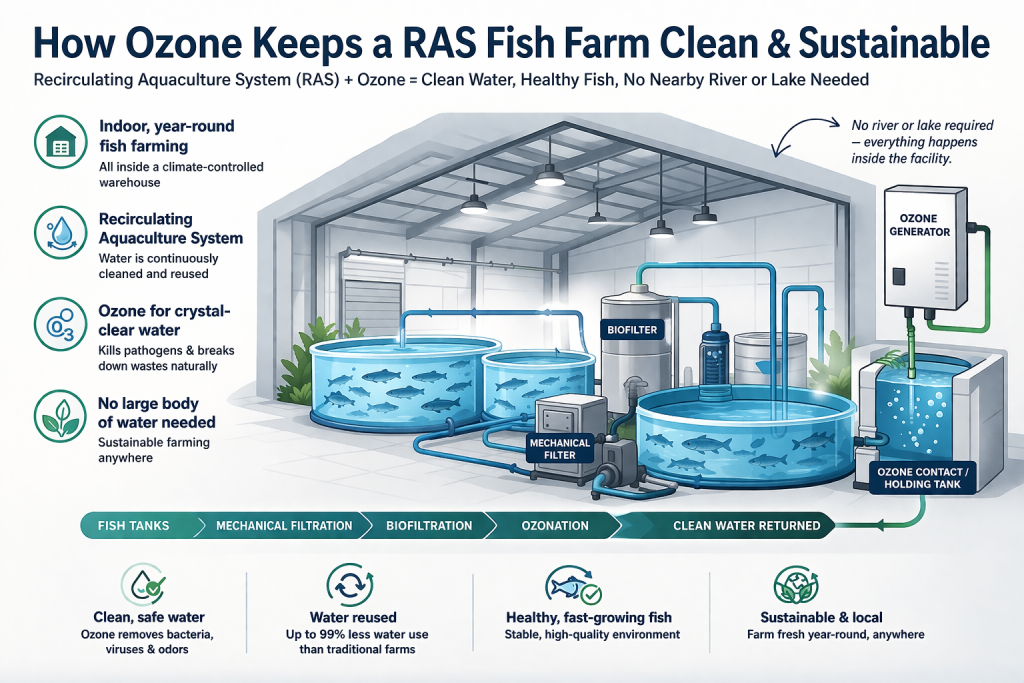
For freshwater RAS operations, the target for residual dissolved ozone after the contact chamber is typically 0.01–0.05 mg/L. Oxidation Reduction Potential (ORP) is measured in millivolts. An ORP is the standard monitoring tool for day-to-day control. Most operators target an ORP reading of 300–400 mV in the fish tank water itself.
Keep Your Biofilter
It is also important to note that ozone does not replace the biofilter. The biological filter in RAS is home to beneficial bacteria that convert fish waste (ammonia) into less toxic compounds. The ozone applied upstream dissipates before water reaches the biofilter. This way, it does not harm those beneficial bacteria that take time to develop.
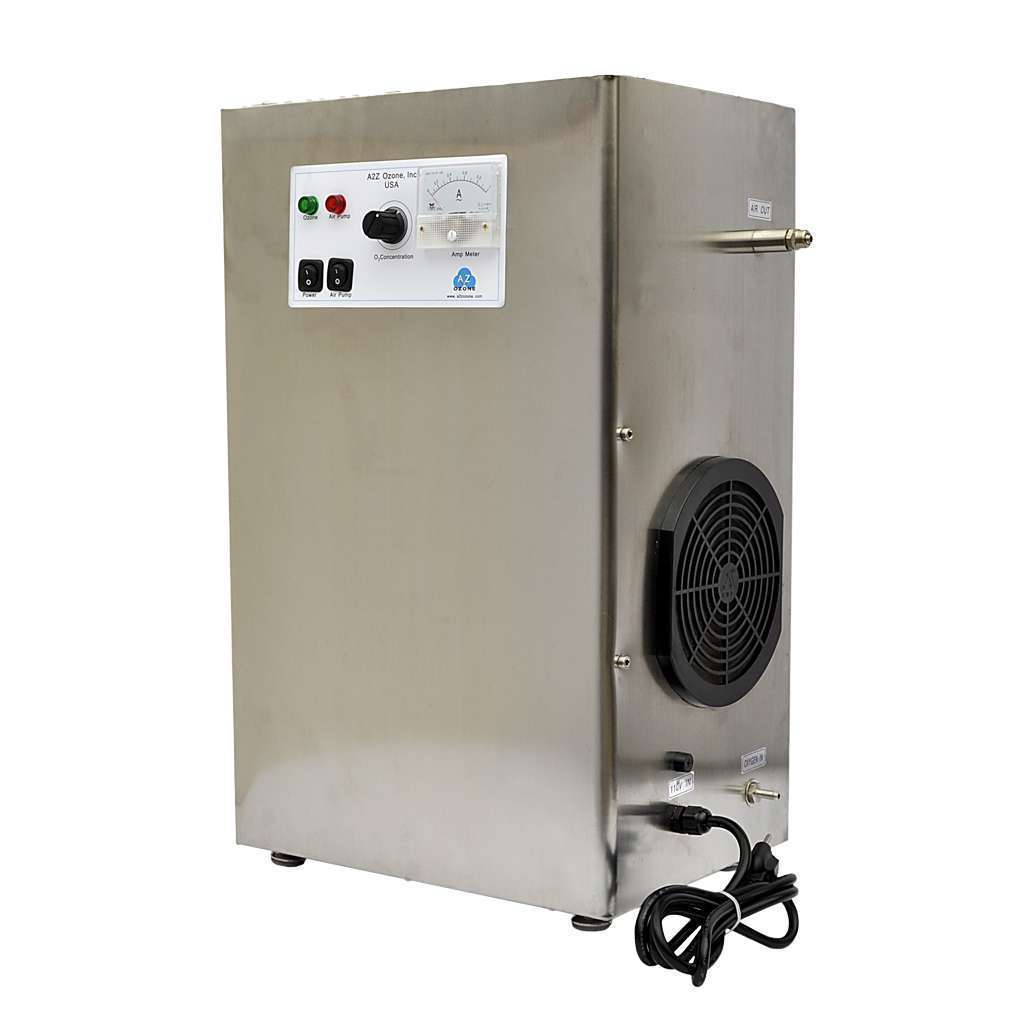
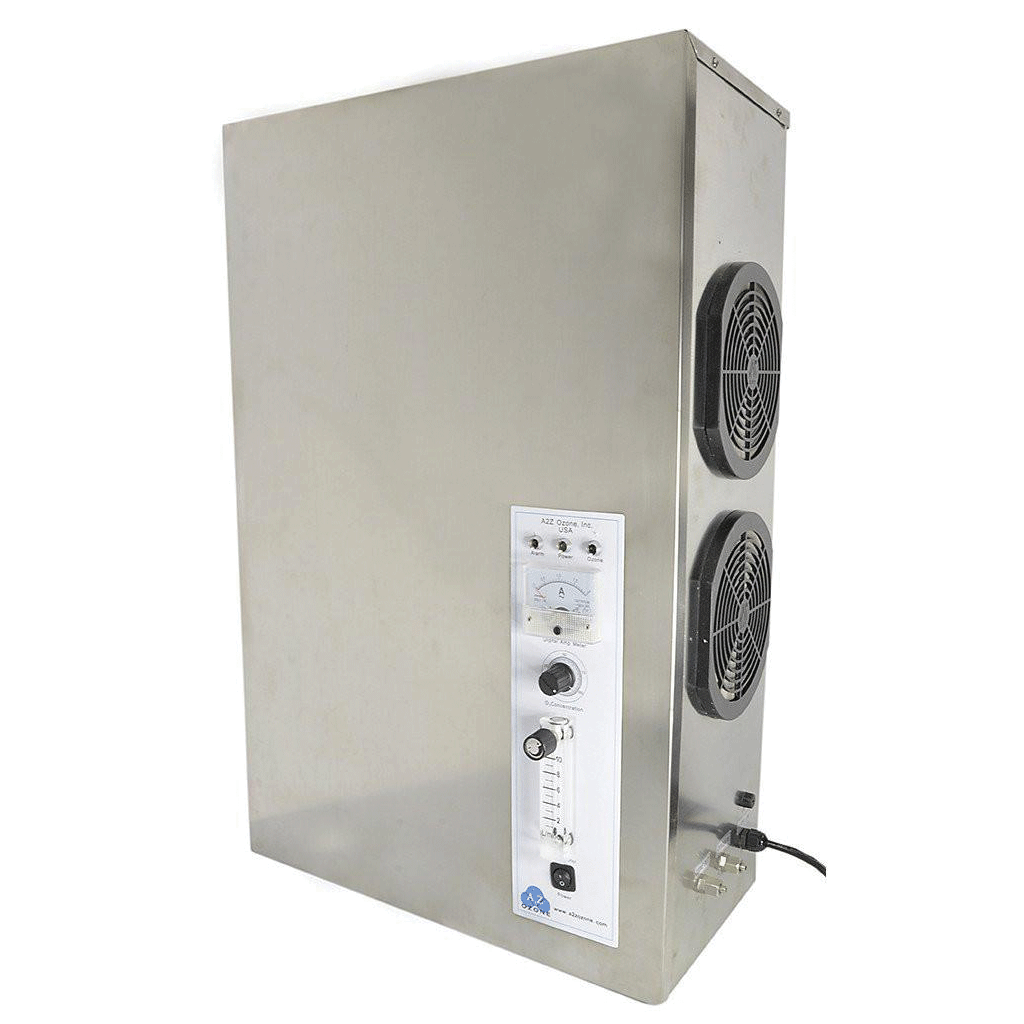
Choosing the Right A2Z Ozone Generator for Your RAS
Correct sizing depends on your total water volume, flow rate, organic load, and fish species, among others. Call Eng. Albert: 502-499-4977, Monday–Friday, 9 am–3 pm Eastern.
Sources
Yousef, A.E. et al. (2024). Frontiers in Microbiology, 14. https://pmc.ncbi.nlm.nih.gov/articles/PMC10829095/
Jhunkeaw, C. et al. (2020). Aquaculture, 534. https://linkinghub.elsevier.com/retrieve/pii/S0044848620339922
Pettersson, S. et al. (2023). Environmental Monitoring and Assessment, 195. https://link.springer.com/10.1007/s10661-023-12117-5
Aguilar-Alarcón, P. et al. (2022). Science of the Total Environment, 842. https://linkinghub.elsevier.com/retrieve/pii/S0048969722041067
Kakhki, S. et al. (2021). Science of the Total Environment, 811. https://linkinghub.elsevier.com/retrieve/pii/S0048969721064822
