


How Ozone Can Help Treat Water Impacted by Old Mines in Eastern Kentucky

Across Eastern Kentucky, thousands of abandoned and legacy coal mines still influence local water. Long after mining stops, water continues moving through exposed rock, fractured seams, and underground voids. And it carries minerals, metals, and sometimes contamination into nearby groundwater, streams, and wells. That is when oxidation from ozone is a practical tool.
The Problem: What Mines Do to Water
Water flowing through abandoned mines often picks up iron and manganese that leave an orange stain. Odors caused by sulfur compounds, low pH, dissolved metals, and bacteria in the stagnant underground zones are all things that cause the “mine-influenced water” or acid mine drainage.
How Ozone Works in Mine-Impacted Water
Fortunately, there is a way to help with these mine issues. Ozone (O₃) is a powerful oxidizer. When injected into water, it reacts quickly and breaks down into oxygen and leaves no chemical residue.
The A2Z Ozone Solution
A2Z Ozone provides corona discharge technology, ozone generators that apply high-efficiency ozone (O₃) oxidation to transform dissolved and reactive contaminants into stable, removable forms, without introducing secondary chemical pollutants.
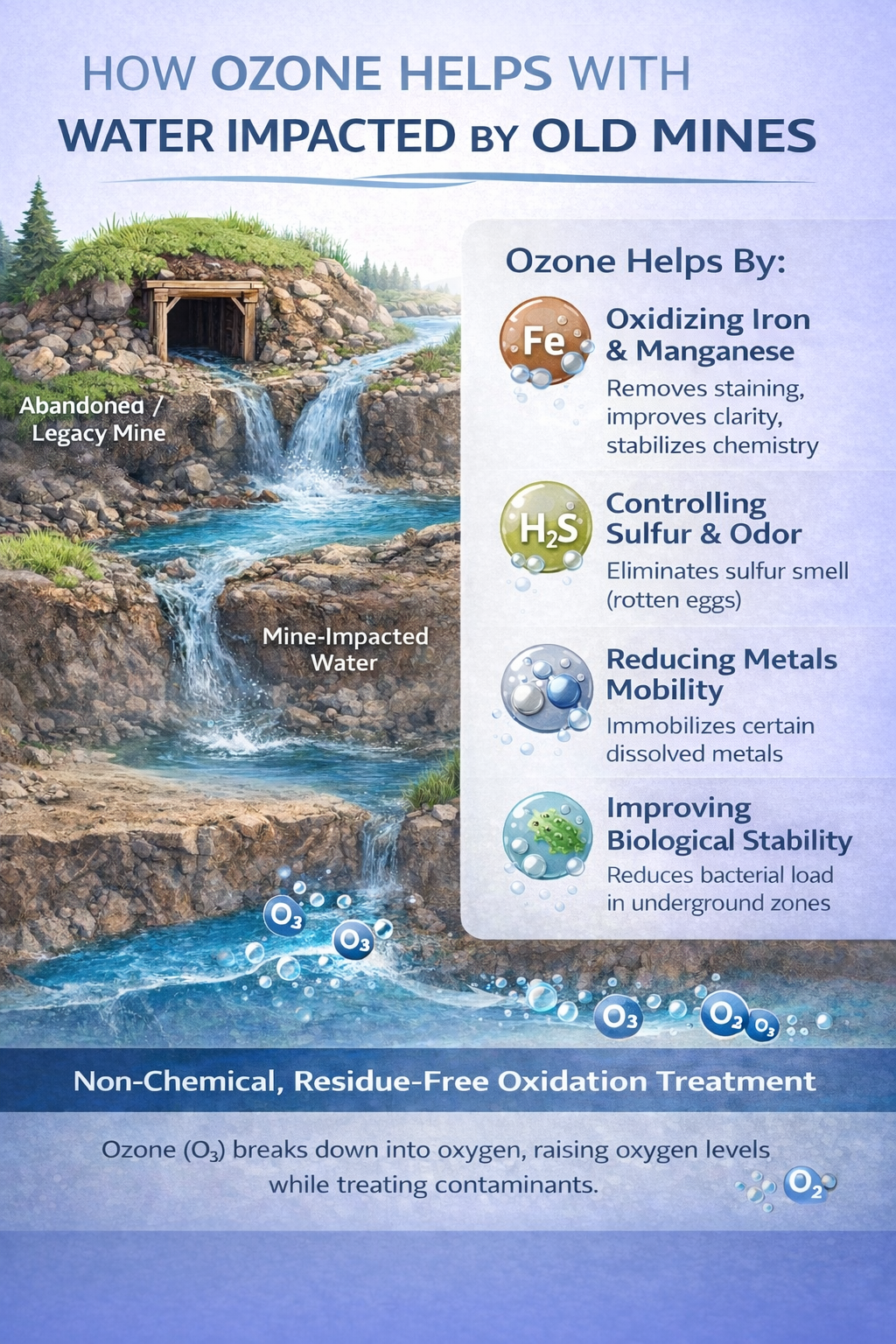
In mine-influenced water, ozone helps by:
1. Oxidizing Iron and Manganese
Ozone converts dissolved iron and manganese into solid particles that can be filtered out. This removes staining, improves clarity, and stabilizes water chemistry.
2. Controlling Sulfur and Odor
Ozone oxidizes hydrogen sulfide and sulfur bacteria, eliminating the common rotten egg smell found in some mine-affected water.
3. Reducing Metals Mobility
Oxidation can convert certain dissolved metals into less mobile, filterable forms helping prevent long-term movement through water systems.
4. Improving Biological Stability
Mine voids can harbor bacteria. Ozone reduces microbial load without adding chemicals, improving water stability.
5. Raising Oxygen Levels
Because ozone breaks down into oxygen, it increases dissolved oxygen, which helps stabilize water chemistry and reduce odor formation.
Where Ozone Helps
As a precaution, customers apply ozone to their private wells near mining areas. They do this after testing the water, and once the ozone takes hold, they test the water again.
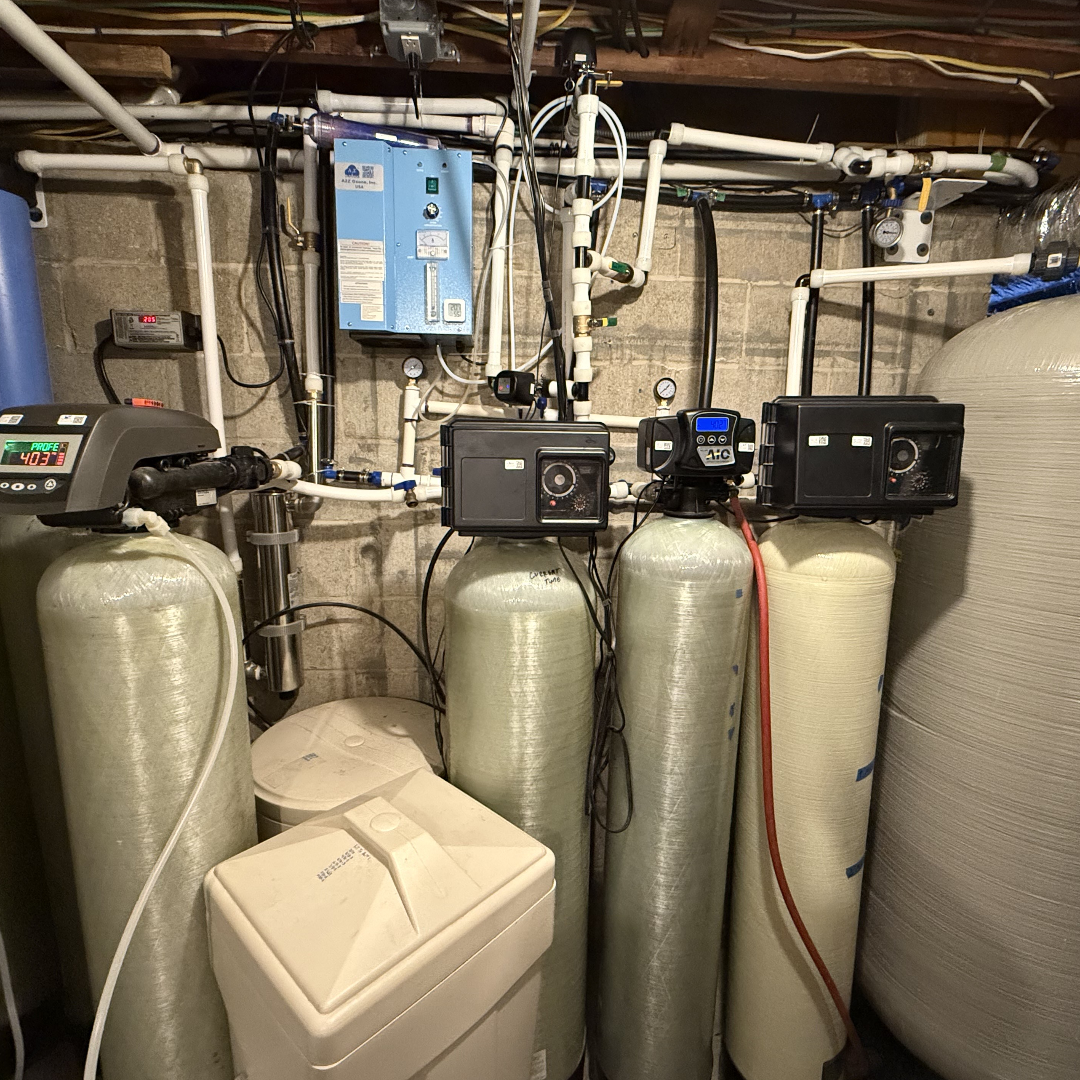
Well Water Setup using the SP-3 Swimming Pool Ozone Generator
Small community water systems will often use ozone. So will the actual mines, they will treat the drainage going into streams and watersheds, or simply for remediation and restoration.
Note, ozone is rarely a standalone solution, but most often part of a broader treatment approach involving filtration, aeration, or neutralization.
Why Ozone Could Matter in Kentucky
Many communities sit above or near legacy mining zones. So even when mines are long closed, underground water pathways remain active. If you are from Kentucky, you probably realize we have many underground caves. Water quality can shift slowly over time, and sometimes goes unnoticed until odor, staining, or tastes appear.
Ozone offers a non-chemical, residue-free way to stabilize and improve water affected by historic mining, especially where iron, sulfur, and biological activity test as present.
Where A2Z Ozone Fits in the Mining Water Treatment Flow
Mine Drainage / Process Water

Equalization Basin
(Flow & load stabilization)
Pre-Settling / Screening
(Removal of coarse solids)
Ozone Oxidation (from A2Z Ozone)
• Iron & manganese oxidation
• Sulfide conversion
• Phenol & COD reduction
• Disinfection
Reaction / Contact Tank
(Complete oxidation & precipitation)
Clarifier / Thickener
(Removal of metal oxides & solids)
Filtration (Sand / Media / Membrane)
(Polishing removal)
Optional Neutralization / Final Polish
(if required)
Reuse Water or Environmental Discharge
The Bigger Picture
Treating mine-influenced water is not just about cleaner water. It supports safer private wells and improved overall rural water quality. Land and site restoration, as well as long-term environmental stability, depend on cleaner water.
Ozone is one tool among many, and in the right conditions, it is a powerful one.